
Can You Assume a VA Loan in Tucson or Vail? What Buyers and Sellers Should Know
Can You Assume a VA Loan in Tucson or Vail? What Buyers and Sellers Should Know
By Billy Morris, Associate Broker, REALTOR®, GRI, MRP · Realty Executives Arizona Territory · Updated November 2026
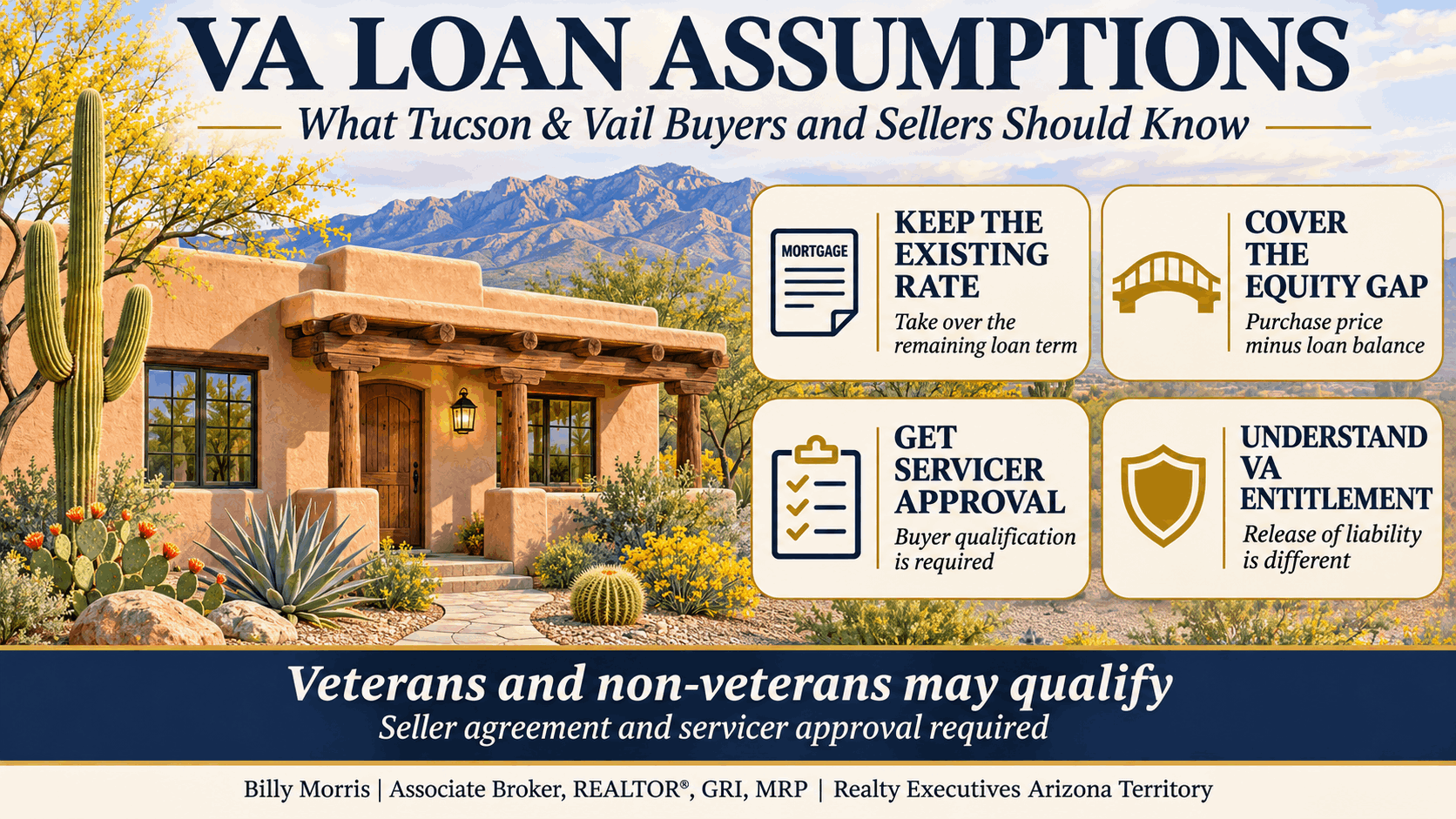
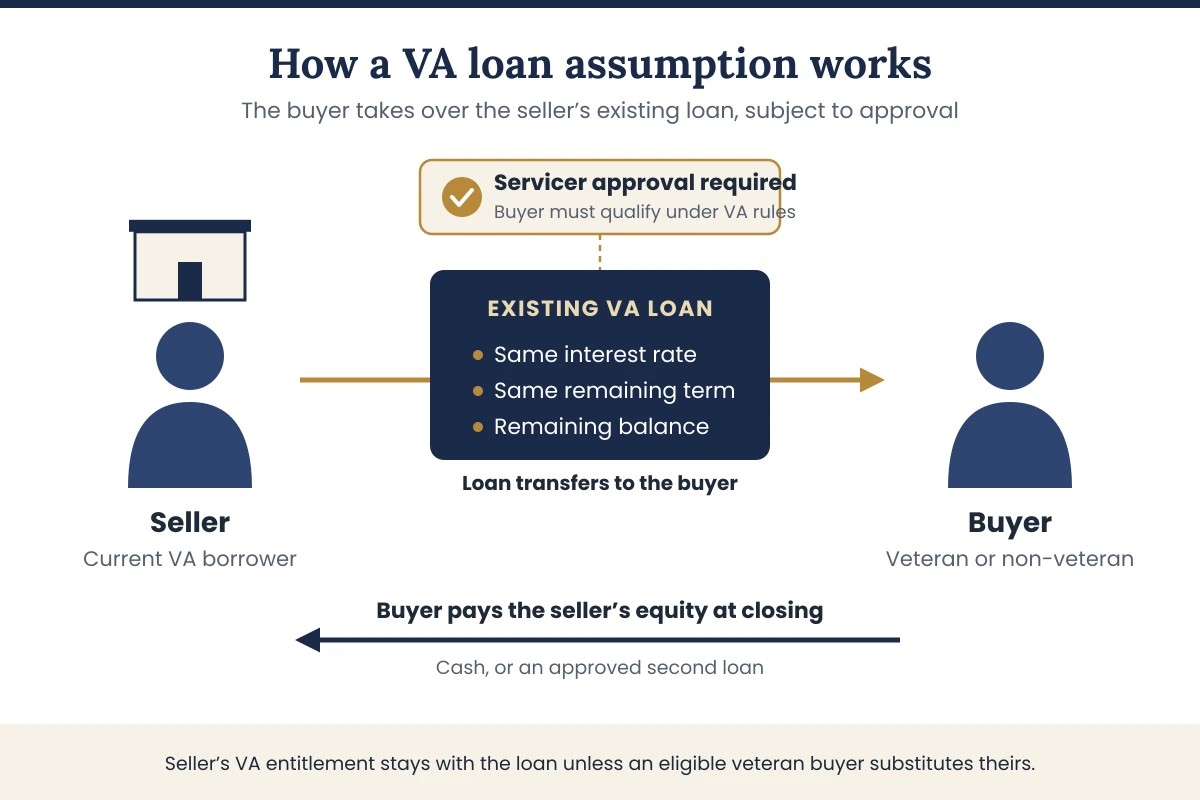
Short answer: Yes. Anyone, veteran or not, can assume a VA loan if the seller agrees, the buyer qualifies with the loan servicer, and the servicer (or VA) approves the transfer. The buyer takes over the existing interest rate and remaining term but usually must pay the seller's equity in cash or with approved secondary financing. Unless a qualifying veteran substitutes entitlement, the seller's VA entitlement stays tied to the loan.
I'm a military veteran and an Associate Broker serving Tucson, Vail and nearby communities, including the Davis-Monthan Air Force Base area, Rita Ranch and Rocking K. A low rate can be a real advantage. It can also hide a large cash requirement. This guide walks through how assumptions actually work, what they cost, and how I check whether one is worth pursuing.
What is a VA loan assumption?
A VA loan assumption is a sale in which the buyer takes over the seller's existing VA-guaranteed mortgage instead of getting a new loan. The buyer becomes responsible for the remaining balance, at the same interest rate, on the same payoff schedule.
VA describes an assumption as a transfer of ownership together with a release of the seller's liability (VA Circular 26-23-10). For loans with commitments made on or after March 1, 1988, the transfer requires approval (38 U.S.C. § 3714). It is not something a buyer and seller can arrange on their own.
Can a non-veteran assume a VA loan?
Yes. You do not need military service or a Certificate of Eligibility to assume a VA loan. VA's test is whether the person assuming the loan is creditworthy under VA's underwriting standards (VA Circular 26-23-10). A Certificate of Eligibility comes into play only when a veteran buyer wants to substitute their own entitlement.
What happens to the interest rate and term?
They stay the same. If the seller's loan has a 2.75% rate and 25 years left, you inherit a 2.75% rate and 25 years left. You do not get a new 30-year term.
That matters in two ways. A shorter remaining term means more of each payment goes to principal. It also means the monthly payment is based on the original loan, not on today's price of the home.
Why can a VA assumption require so much cash?
Because you are buying the home at today's price but only taking over what the seller still owes. The difference between the purchase price and the remaining loan balance is called the equity gap, and you have to cover it at closing.
VA loans are known for $0 down when you get a new VA loan. An assumption works differently. The existing loan does not grow to match the purchase price, so the seller's equity has to be paid some other way.
How the numbers fit together
Here is a simple hypothetical example:
- Purchase price: $450,000
- Remaining loan balance you assume: $350,000
- Equity gap you must cover: $100,000
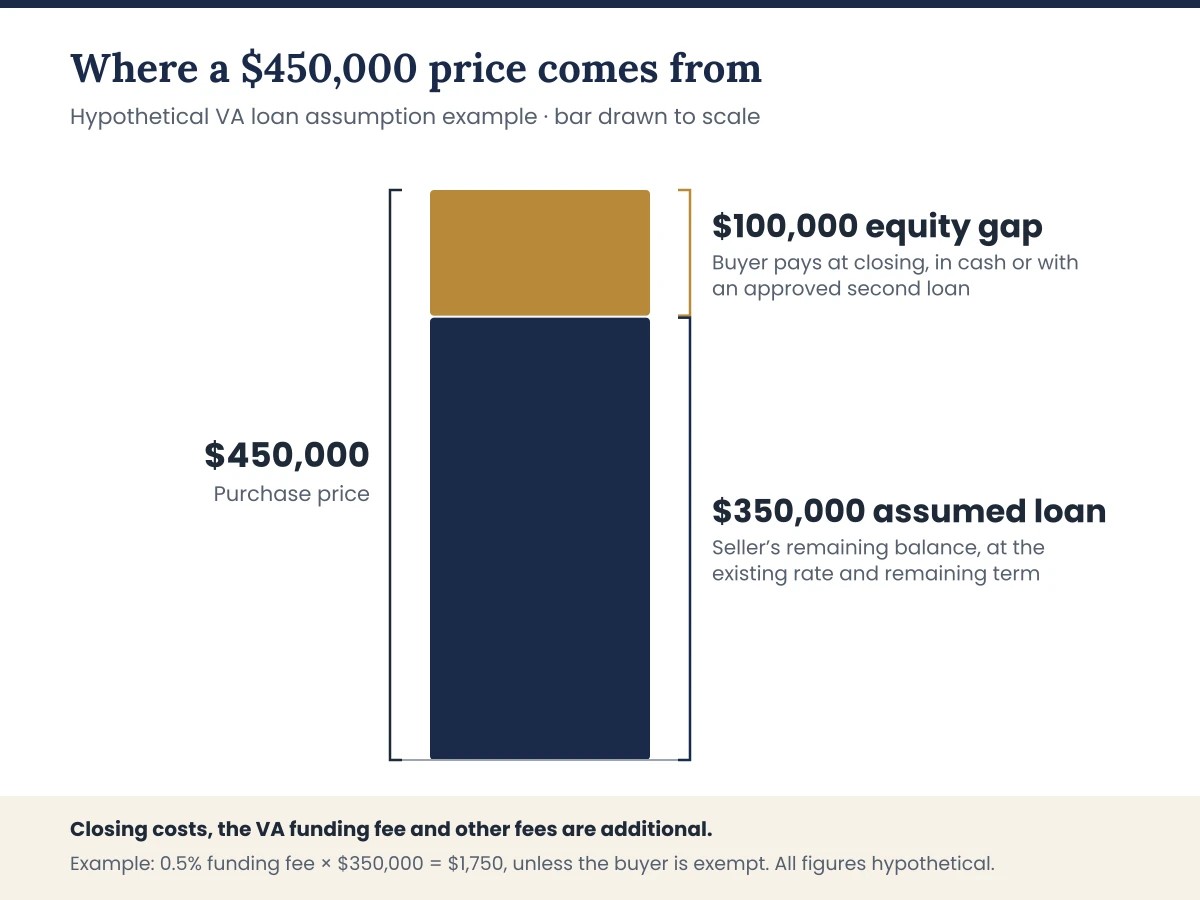
Losing costs, the VA funding fee and other fees are paid on top of the equity gap. In this example, your cash or other financing at closing would be more than $100,000.
The gap tends to be largest when the seller bought years ago, the home has gained value, or the seller has paid the loan down. A home with a newer loan and a small gap may be easier to buy by assumption than one with a lower rate and a big gap.
What does it cost to assume a VA loan?
The VA-specific fees on an assumption are modest. The bigger costs are the equity gap, normal closing costs and the monthly obligations that come with the house.
VA funding fee
The VA funding fee on an assumption is 0.5% of the loan balance (VA.gov). On a $350,000 balance, that is $1,750. Unlike a new VA purchase loan, the assumption funding fee must be collected at closing and may not be financed into the loan balance (VA Circular 26-23-10).
The exemption depends on the buyer's status, not the seller's. According to VA.gov, you do not pay the funding fee if any of these apply to you:
- You receive VA compensation for a service-connected disability.
- You are eligible for that compensation but receive retirement or active-duty pay instead.
- You receive Dependency and Indemnity Compensation (DIC) as the surviving spouse of a veteran.
- You are a service member with a proposed or memorandum rating, before closing, that says you are eligible for compensation from a pre-discharge claim.
- You are on active duty and, on or before closing, provide evidence that you received a Purple Heart.
The lender or servicer confirms exemption status. Don't assume you're exempt until it is documented.
Servicer and closing fees
VA limits what the person assuming the loan can be charged (VA Circular 26-23-10, Change 1):
- Assumption processing fee: up to $300.
- Assumption locality variance: VA has authorized an additional regional amount; Arizona falls in the West region at $463 (VA Circular 26-24-5, Exhibit A).
- Other allowable charges: credit report, recording fees and taxes, title examination and title insurance, and applicable taxes, insurance and assessments.
VA states that fees not expressly permitted may not be charged to or paid by the person assuming the loan. Before writing an offer, talk through how every cost will be handled, including real estate compensation.
Monthly costs beyond principal and interest
The seller's old payment is not your new payment. Verify each of these yourself:
- Property taxes. Look up the parcel on the Pima County Treasurer's website and confirm how the escrow account will be handled at transfer.
- Homeowners insurance. You will need your own policy, and premiums can differ from what the seller pays.
- HOA dues and transfer fees. If the home is in an HOA, get current dues, any special assessments and the transfer fees in writing.
- Solar obligations. If the panels are leased or under a power purchase agreement, the lease does not automatically come with the house. You may need to apply and qualify with the solar company separately, and approval is not guaranteed (Arizona Daily Star / This Is Tucson). That payment can also affect your debt-to-income ratio.
- Secondary financing payment. If you borrow to cover the equity gap, that payment is part of your monthly cost and your qualification.
Who has to say yes to a VA loan assumption?
Several separate decisions have to line up, and each one answers a different question. People often treat "assumable" as a yes to all of them. It isn't.
Seller willingness
Who decides: The seller
The question: Will I sell this way, knowing what it means for my entitlement?
Buyer qualification
Who decides: The loan servicer, under VA standards
The question: Is this buyer creditworthy, and is the loan current?
Servicer approval
Who decides: The servicer, or VA if the servicer lacks automatic authority
The question: Does the file meet VA's requirements to transfer?
Release of liability
Who decides: Granted with an approved assumption
The question: Is the seller off the hook if the buyer later defaults?
Entitlement restoration
Who decides: Happens only through substitution or payoff
The question: Does the seller get their VA benefit back?
How long does servicer approval take?
VA requires a servicer with automatic authority to decide within 45 calendar days of receiving a complete application package. If the application is denied, the buyer or seller may appeal to VA within 30 calendar days (VA Circular 26-23-10; 38 CFR 36.4303). The clock starts only when the package is complete, and delays outside the servicer's control can extend it. I can't promise a closing date, and neither can anyone else, so build realistic time into your contract.
The loan also has to be current, or brought current at or before closing.
Release of liability vs. restoration of entitlement
These are two different things, and sellers often assume one means the other.
- Release of liability means the seller is no longer responsible to VA for the loan. Federal law provides for this when an assumption is approved under its requirements (38 U.S.C. § 3714). Sellers should get the release in writing and keep it.
- Restoration of entitlement means the seller gets back the VA entitlement used on this loan, for use on a future home.
When the buyer is not a veteran substituting entitlement, VA says the original veteran's entitlement "remains encumbered by the loan until the loan is paid in full" (VA Circular 26-23-10). The seller can still have remaining entitlement for another VA loan, but it may be reduced. A VA lender can calculate what's left for a specific seller.
What is substitution of entitlement?
If the buyer is an eligible veteran who intends to live in the home and has enough entitlement, they can substitute their entitlement for the seller's. The servicer requests a Certificate of Eligibility to confirm it. That frees the seller's entitlement.
VA now requires servicers to give selling veterans VA Form 26-10291, the Assumption Entitlement Acknowledgement, to sign no later than closing (VA Circular 26-24-9). Its purpose is to make sure sellers understand how an assumption affects their entitlement before they commit.
Why would a veteran sell to a non-veteran?
Every seller's situation is different. A seller may not plan to use a VA loan again, may have enough remaining entitlement for their next purchase, or may weigh a strong offer above the entitlement trade-off. That is the seller's decision to make with good information, which is why I ask the listing agent early rather than guessing.
Can you finance the equity gap with a second loan?
Sometimes. VA does not prohibit a buyer from using a second loan to help cover the equity gap, but the servicer and the second lender both have to make it work, and many buyers still need significant cash.
VA's rules for a second loan used with an assumption (VA Circular 26-24-17) include:
- The second loan must sit in a junior lien position behind the VA loan.
- The servicer must document the second lender, the amount and the repayment terms.
- The buyer may not receive cash back from the second loan.
- The second loan's monthly payment must be counted when the servicer evaluates the buyer's debts.
- The second loan should include a reasonable grace period before late charges or foreclosure.
The limits to keep in mind
- Availability isn't guaranteed. VA allows second loans; it doesn't require any lender to offer one or any servicer to accept a particular structure.
- Second loans usually cost more. A higher rate on the second loan raises your blended cost, so the headline rate on the first loan is not your true rate.
- It adds a payment. That payment can affect whether you qualify at all.
- It can add time. Coordinating a second lender with the servicer's assumption process takes planning.
I help coordinate with the financing professionals involved, but I'm not a lender. The lender decides what is available and on what terms.
Is assuming a VA loan better than getting a new mortgage?
It depends on the rate gap, the equity gap and your cash. An assumption usually wins on monthly principal and interest. A new mortgage usually wins on cash needed at closing. The only way to know is to run both for the specific home.
| Feature | VA loan assumption | New mortgage |
|---|---|---|
| Interest rate | Seller's existing rate | Today's market rate |
| Repayment term | Whatever is left on the seller's loan | New full term, often 30 years |
| Cash at closing | Equity gap plus closing costs | Down payment (can be $0 on a new VA loan) plus closing costs |
| VA funding fee | 0.5% of balance, paid at closing, unless exempt | Varies by loan type; can be financed on a new VA purchase loan |
| Who can use it | Any creditworthy buyer the servicer approves | Depends on loan program |
| Approval | Seller's servicer, under VA rules | Lender you choose |
| Timing | Servicer has 45 days after a complete package; total time varies | Set by your lender and contract |
| Effect on seller's VA entitlement | Stays tied up unless a veteran substitutes | Seller's loan is paid off |
On a phone? Here's the same comparison in short form:
- Rate: assumption keeps the seller's rate; a new loan uses today's rate.
- Term: assumption keeps the remaining term; a new loan starts fresh.
- Cash: assumption needs the equity gap; a new VA loan can be $0 down.
- Funding fee: 0.5% paid at closing on an assumption; financeable on a new VA purchase loan.
- Approval: the seller's servicer vs. your chosen lender.
- Seller's entitlement: tied up after a non-veteran assumption; freed when a new loan pays theirs off.
How to compare the two, step by step
- Hold the comparison constant. Use the same home, the same price and the same monthly extras (taxes, insurance, HOA, solar).
- Compare principal and interest. Then add the payment on any second loan you'd use for the equity gap.
- Compare cash to close. Include the equity gap, funding fee and every closing cost.
- Count what your cash could do elsewhere. Money used for the gap isn't available for reserves or other goals.
- Ask your lender to run both with real quotes, not averages.
A worked example (hypothetical)
The chart below isolates the effect of the interest rate alone: the same $350,000 balance and the same 25 years remaining, at different hypothetical rates.
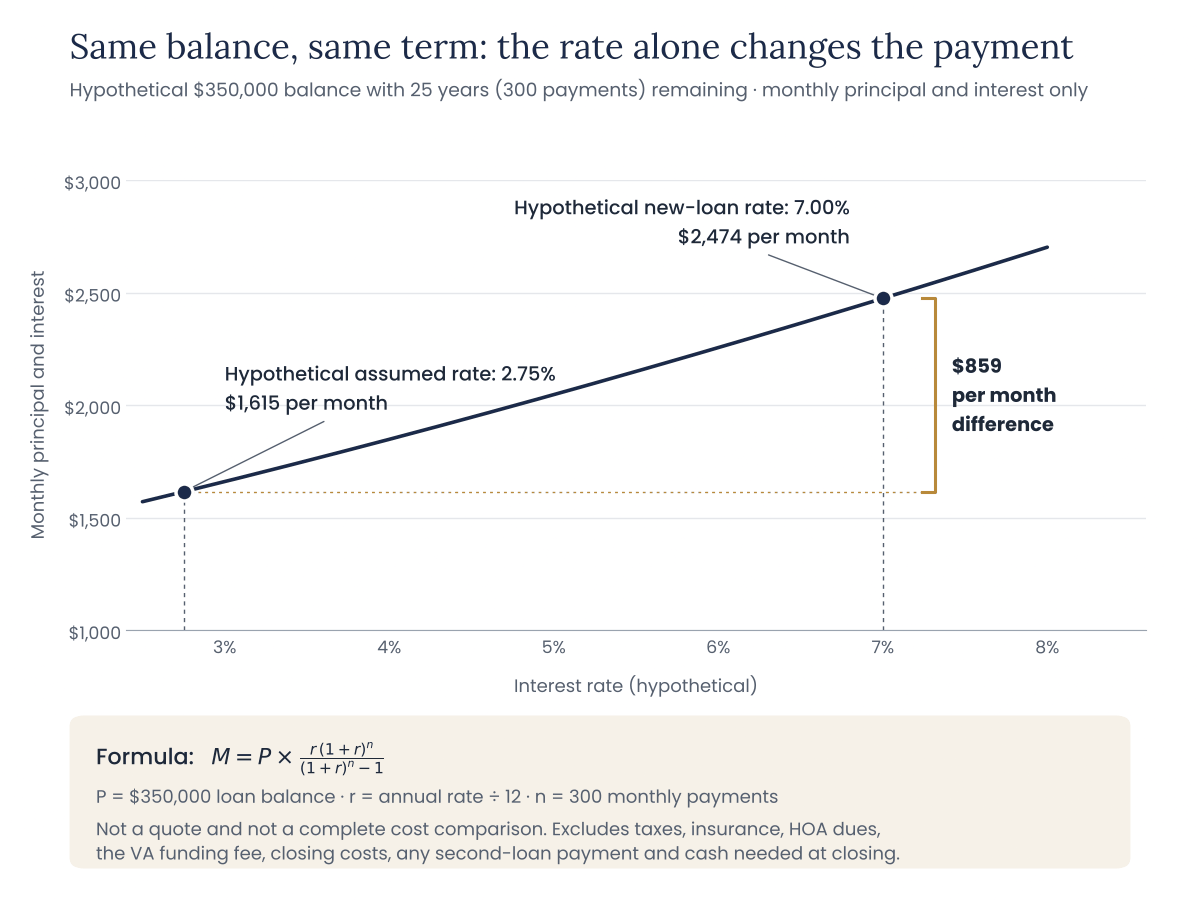
- $350,000 at a hypothetical 2.75% for 25 years: about $1,615 a month in principal and interest.
- The same $350,000 at a hypothetical 7.00% for 25 years: about $2,474 a month.
Now add the equity gap. Say you cover the $100,000 gap with a hypothetical second loan at 9.00% for 20 years: about $900 a month. Your combined principal and interest would be about $2,514. Compare that with a hypothetical new $450,000 loan at 7.00% for 30 years, about $2,994 a month, and with the cash each option needs at closing.
These figures use the standard amortization formula and exclude taxes, insurance, HOA dues, funding fees and closing costs. They are not a quote and not a complete total-cost comparison. Your lender can model your actual numbers.
How do you find homes with assumable VA loans around Tucson and Vail?
Start with listings that mention an assumption, then verify every detail before you treat the home as an assumption opportunity. A listing that says "assumable" is a lead, not a confirmation.
What the MLS "Assumption" checkbox does and doesn't tell you
When a listing agent checks "Assumption" in the MLS financing terms, it signals the seller may consider it. It does not confirm:
- that the loan is a VA loan, or that it's the rate you've heard;
- the current balance, remaining term or payment;
- that the loan is current;
- that the seller will accept a non-veteran buyer;
- that the servicer will approve you; or
- that the numbers work for you once the equity gap is counted.
Those answers come from the seller, the servicer and your own financing plan.
How I investigate an assumption listing
When a client is interested in a home advertised as assumable, here's how I approach it:
- Review the listing information. I read the remarks, financing terms and disclosures for what's stated and what's missing, including HOA and solar details.
- Follow up with the listing agent. I ask directly whether the seller will consider an assumption and, if my client isn't a veteran, whether a non-veteran buyer is acceptable.
- Confirm the seller's willingness in writing before my client spends money on inspections or applications.
- Gather the loan details available. That means the loan type, servicer, approximate balance, interest rate, remaining term, current payment and whether the loan is current. Sellers can usually get these from their latest mortgage statement.
- Coordinate with the right financing professionals. The servicer handles the assumption; a lender may be needed for any second loan. I help keep timelines and documents moving, but the lending decisions belong to them.
- Run the comparison. We look at the equity gap, total cash to close and the monthly cost against a new mortgage before writing an offer.
Where to look
- MLS searches for listings with assumption in the financing terms or remarks. Your agent can run these and set alerts.
- Consumer listing sites, using keyword searches such as "assumable" or "VA assumption" in the listing description.
- Homes you already like. Even when a listing doesn't mention it, your agent can ask whether the seller has a VA loan and would consider an assumption.
VA loan assumption checklist for buyers
Before you make an offer on a home with an assumable VA loan, confirm:
- The seller is willing to sell by assumption, and will accept a non-veteran if that applies to you.
- The loan type, servicer, approximate balance, interest rate and remaining term.
- The loan is current, or will be brought current by closing.
- The equity gap, and exactly how you will pay it.
- If you plan a second loan: a lender willing to offer it, its rate and term, and its payment.
- The 0.5% VA funding fee, or documentation that you're exempt.
- The servicer's processing fee and all other closing costs.
- Current property taxes, using the county's records.
- A homeowners insurance quote in your name.
- HOA dues, special assessments and transfer fees.
- Whether solar panels are owned, financed or leased, and the transfer requirements if they aren't owned.
- A contract timeline that allows for the servicer's review.
- Your full monthly payment compared with a new-mortgage alternative.
Frequently asked questions about VA loan assumptions
Can a civilian assume a VA loan in Arizona?
Yes. VA loans can be assumed by any buyer who meets VA's credit standards and is approved by the loan servicer. Military service isn't required.
Do I need a Certificate of Eligibility to assume a VA loan?
No, not as a non-veteran. A Certificate of Eligibility is needed only when a veteran buyer substitutes their entitlement for the seller's.
Do I get the seller's interest rate?
Yes. You take over the loan's existing rate, remaining balance and remaining term.
How much cash do I need to assume a VA loan?
Usually the equity gap, which is the purchase price minus the loan balance, plus closing costs and the 0.5% funding fee unless you're exempt. On many homes that is a substantial amount.
Can the VA funding fee be rolled into an assumed loan?
No. VA requires the assumption funding fee to be collected at closing; it may not be financed into the loan balance.
Who is exempt from the funding fee on an assumption?
Exemption depends on the buyer's status, such as receiving VA disability compensation or DIC as a surviving spouse. Your lender or servicer confirms it.
Is the seller still responsible for the loan after an assumption?
An approved assumption includes a release of liability for the seller. Sellers should keep the written release.
What happens to the seller's VA entitlement?
If a non-veteran assumes, the seller's entitlement used on that loan stays tied up until the loan is paid in full. If an eligible veteran substitutes entitlement, the seller's entitlement is freed.
How long does a VA loan assumption take?
VA requires servicers with automatic authority to decide within 45 days of a complete application. Total time to close depends on the file, the servicer and any second loan, so no one can guarantee a date.
Can I use a second mortgage for the equity gap?
VA allows it if the second loan is subordinate, gives you no cash back and its payment is counted in your qualification. Whether a lender will offer one is a separate question.
Does "Assumption" in the MLS mean the loan is definitely assumable for me?
No. It means the seller may consider an assumption. The loan details, the seller's acceptance of your offer and the servicer's approval all still need to be confirmed.
How I can help you evaluate a VA loan assumption
An assumption has more moving parts than a typical purchase, and most of the risk sits in details a listing doesn't show. Here is what I bring to it:
- A veteran's understanding of the VA benefit, including why entitlement matters so much to the seller on the other side of the deal.
- The Military Relocation Professional (MRP) certification, focused on serving military and veteran households.
- A step-by-step review process: reviewing the listing, following up with the listing agent, confirming the seller's willingness, gathering available loan details and coordinating with the servicer and any lender involved.
- Local knowledge of Tucson, Vail, Corona de Tucson, Marana, Sahuarita and Oro Valley, including the neighborhoods around Davis-Monthan, Rita Ranch and Rocking K.
- A straight comparison of the assumption against a new mortgage, so you can decide with the full numbers in front of you.
Whether you're a military family, a veteran, a civilian buyer, or a homeowner wondering whether your assumable loan could help you sell, I'm happy to help you think it through.
Thinking about an assumable VA loan in Tucson or Vail? Call me at 520-256-6697 or reach out through billymorrisrealestate.com. I'll help you look at a specific home, gather the loan details and run the numbers before you commit.
About the author
Billy Morris is an Associate Broker, REALTOR®, GRI and MRP with Realty Executives Arizona Territory, and a military veteran. He has been licensed in Arizona real estate since 2014 and helps buyers and sellers in Tucson, Vail, Corona de Tucson, Marana, Sahuarita and Oro Valley, including military households, veterans, civilian buyers, relocating families and owners selling homes with assumable loans.
Disclaimer: Billy Morris is a real estate broker, not a lender, loan servicer or representative of the U.S. Department of Veterans Affairs. This article is general information, not legal, tax or financial advice. Loan approval, timelines, fees and the availability of secondary financing are determined by the servicer, VA and lenders and are not guaranteed. Verify all figures with the appropriate professionals before making decisions.
Sources
Verified November 14, 2026.
- VA funding fee and loan closing costs — VA.gov
- VA Circular 26-23-10: VA Assumption Updates
- VA Circular 26-23-10, Change 1: assumption fees
- VA Circular 26-24-5, Exhibit A: assumption locality variance
- VA Circular 26-24-9: Assumption Entitlement Acknowledgement
- VA Circular 26-24-17: secondary borrowing on assumptions
- 38 U.S.C. § 3714: assumptions and release from liability
- 38 CFR § 36.4303: reporting requirements, including assumptions
- Pima County Treasurer
- Buying a home with solar panels — This Is Tucson
Categories
Recent Posts









JOIN MY WEEKLY INNER CIRCLE EMAIL
One useful Tucson & Vail email a week.
Found this helpful?
Know someone who's buying, selling, or renting in the Tucson area?
If this article answered a question for you, it may help someone you know. Send it to them, or send them my contact card. Most of my business comes from introductions like that. I reach out once, mention you, and never pressure anyone.
Billy Morris, REALTOR® | Realty Executives Arizona Territory | Equal Housing Opportunity