Getting Cash Offers for Your Home? What Arizona Sellers Should Know About Real Estate Wholesalers
Before apting an unsolicited cash offer, understand who may be making the offer, how real estate wholesaling works, and what options you have as a homeowner.
If you own a home in Tucson, Vail, Sahuarita, Marana, Oro Valley, or surrounding Southern Arizona, you've probably received a phone call, text message, postcard, or letter from someone offering to buy your home for cash.
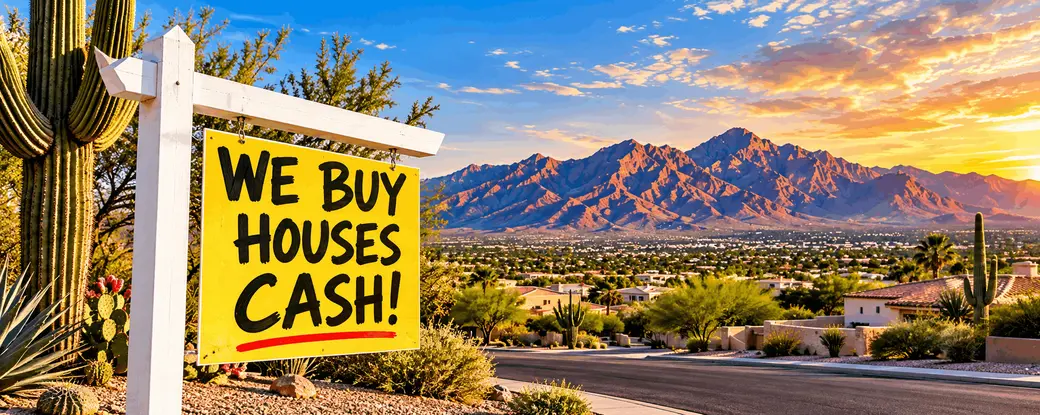
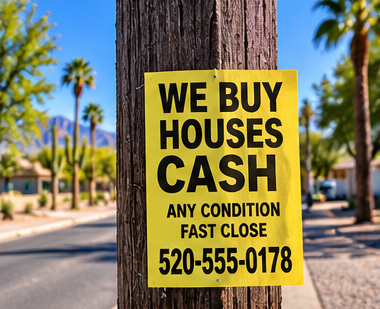
You've probably also noticed handwritten-looking signs attached to utility poles or placed along busy roads advertising:
-
"We Buy Houses for Cash!"
-
"Sell Your Home Fast!"
-
"No Repairs Necessary!"
-
"Close in Days!"
These offers can sound appealing, particularly if you're facing an unexpected move, financial pressure, costly repairs, or simply want to sell without preparing your home for the market.

But here's an important question:
Is the person offering to buy your home actually planning to purchase it?
In some cases, the answer is no.
Some offers come from real estate wholesalers who intend to transfer their purchase contracts to other investors rather than purchase the property themselves.
Wholesaling can be a legitimate real estate investment strategy. However, homeowners should understand how these transactions work before entering into a binding agreement.
What Is a Real Estate Wholesaler?
A real estate wholesaler typically enters into a purchase agreement with a homeowner and then assigns their contractual rights to another buyer, often an investor, for a fee.
In an assignment transaction, the wholesaler may never actually take ownership of the property.
Instead, the wholesaler's business opportunity comes from negotiating a purchase price with the homeowner and finding another buyer willing to pay more for the contractual rights.
Here's a Simplified Example
Imagine a homeowner agrees to sell a property to a wholesaler for $240,000.
The wholesaler then finds an investor willing to pay $260,000 to acquire the property through an assignment arrangement.
The difference may result in a $20,000 assignment fee paid to the wholesaler.
The homeowner receives the agreed $240,000 purchase price, subject to applicable closing expenses, while the investor ultimately purchases the home.
The wholesaler may earn a fee without ever owning the property.
This example is hypothetical. Actual transaction structures, assignment fees, property values, and closing costs vary.
The concern isn't necessarily that someone earns a profit. The important question is whether the homeowner understands the transaction and has evaluated the property's potential market value before accepting the offer.
Why Do Wholesalers Contact Homeowners Directly?
Wholesalers frequently seek properties they believe can be purchased at prices attractive to other investors.
Some focus on homes requiring repairs, properties owned by people seeking a convenient sale, or situations where homeowners want to move quickly.
Their advertising often emphasizes convenience:
-
No repairs or renovations.
-
No traditional listing process.
-
No public showings.
-
Flexible closing dates.
-
A straightforward cash transaction.
These benefits can have real value.
However, convenience should be evaluated alongside the purchase price, contract terms, closing certainty, and potential net proceeds.
A homeowner who needs to sell quickly may have other options worth considering, including marketing the property as-is through a licensed real estate professional.
Seven Contract Terms Every Homeowner Should Understand
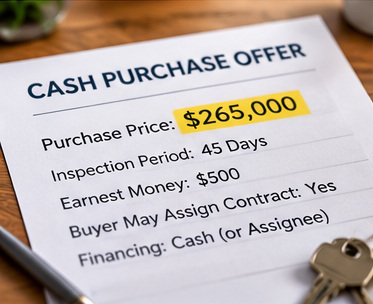
Not every investor purchase agreement is problematic, and no single contract feature automatically indicates wrongdoing.
Nevertheless, several provisions deserve careful review before signing.
1. Who Is Actually Buying Your Home?
The buyer may be an individual investor, an investment company, or a limited liability company (LLC).
Purchasing through an LLC is common and legitimate.
However, you should understand whether the buyer intends to purchase the property directly or transfer the contract to another party.
Ask: "Are you purchasing my home yourself, or do you intend to assign this contract to another buyer?"
2. How Much Earnest Money Is Being Deposited?
Earnest money is generally deposited as part of a purchase agreement and may provide financial protection depending on the contract's terms.
Some wholesale agreements involve relatively small earnest-money deposits. Others may provide broad opportunities for the buyer to recover the deposit.
Review how much earnest money is required, when it must be deposited, who will hold it, and what happens if the buyer cancels.
Ask: "How much earnest money will be deposited with the escrow company, and under what circumstances would I be entitled to keep it?"
3. Can the Buyer Assign the Purchase Contract?
An assignment provision may allow the buyer to transfer contractual rights to another party.
This is particularly important in wholesaling because the original buyer may intend to earn an assignment fee rather than complete the purchase personally.
Assignment rights depend on the contract and applicable law. A separate seller approval is not automatically required for every assignment.
Ask: "Does this contract allow assignment, and who remains responsible if the assigned buyer fails to close?"
4. Can a Memorandum of Contract Be Recorded?
Some agreements contain provisions authorizing a buyer to record a memorandum or notice of the purchase contract in public records.
Depending on the circumstances, such a recording may create a title issue that complicates a future sale.
If a transaction fails, resolving that issue could require additional time, expense, or legal assistance.
Ask: "Will anything be recorded against my property, and how will it be released if the transaction does not close?"
Before agreeing to such a provision, consider having an Arizona real estate attorney review it.
5. Can the Buyer Demonstrate the Ability to Close?
A cash offer should not automatically be interpreted as a guaranteed closing.
The buyer may be using personal funds, financing, another investor's funds, or a transaction structure involving an assignment.
Ask for reasonable evidence of the proposed funding arrangement and whether the closing depends on finding another buyer.
Ask: "Can you provide evidence that the transaction can be funded by the agreed closing date?"
6. How Long Can the Buyer Cancel?
Some purchase agreements contain inspection or due-diligence periods that allow the buyer to terminate the transaction under specified circumstances.
If the buyer cancels near the end of a lengthy period, the seller may have lost valuable marketing time.
This can be particularly consequential when the homeowner has an urgent deadline.
Ask: "What are your cancellation rights, and what happens if you decide not to proceed?"
7. How Does the Offer Compare With Your Home's Market Value?
A direct investor offer may be lower than a property's potential open-market selling price.
The difference may account for repairs, resale expenses, holding costs, transaction risks, and the investor's expected profit.
A lower offer isn't automatically inappropriate. The question is whether the convenience and other benefits justify the financial trade-offs for your circumstances.
Ask: "What might my home realistically sell for if it were exposed to the broader market?"
Additional Warning Signs Before Signing
Beyond the contract provisions themselves, pay attention to how the offer is presented.
Be cautious when someone:
-
Pressures you to sign immediately without allowing independent review.
-
Guarantees an unusually fast closing without demonstrating the ability to perform.
-
Discourages you from obtaining a comparative market analysis or legal advice.
-
Makes unsupported claims about your home's value or repair costs.
-
Uses financial hardship or foreclosure concerns to create unnecessary pressure.
-
Refuses to explain whether they are acting as an investor, wholesaler, or licensed real estate professional.
-
Minimizes the possibility that the transaction could be delayed or fail.
Not every cash buyer or wholesaler engages in these practices. The purpose of recognizing warning signs is to help you ask informed questions before making a significant financial decision.
Arizona Law Requires Certain Wholesaling Disclosures
Arizona has specific disclosure requirements for residential real estate wholesaling.
Under Arizona Revised Statutes § 44-5101, a wholesale buyer must disclose in writing to the seller that the buyer is acting as a wholesale buyer before the parties enter into a binding agreement.
The law also requires a wholesale seller to make specified written disclosures to the buyer.
For purposes of the statute, residential real property generally means property containing fewer than five dwelling units.
What Happens if a Wholesale Buyer Fails to Disclose?
Under A.R.S. § 44-5101, when a wholesale buyer violates the statutory disclosure requirement, the seller may cancel the purchase contract before the close of escrow without penalty and may retain earnest money paid by the wholesale buyer.
These rights arise under the circumstances specified in the statute. They do not provide an unrestricted right to cancel every cash purchase agreement.
Read Arizona's wholesaling disclosure law — A.R.S. § 44-5101
If you've already signed an agreement and have concerns about the buyer's conduct, cancellation rights, or recorded documents, consult a qualified Arizona real estate attorney promptly.
What Happens if the Wholesaler Cannot Find Another Buyer?
This is an important consideration for homeowners who need to sell within a particular timeframe.
Depending on the purchase agreement, a wholesaler may have time to locate another investor before closing.
If an investor cannot be found, the wholesaler may request an extension, exercise a contractual cancellation right, or fail to complete the transaction.
The homeowner may then need to begin the selling process again.
If a memorandum or other document has been recorded against the property, resolving potential title complications may require additional steps.
Not every wholesale transaction encounters these problems. Nevertheless, sellers should understand the risks and contractual protections before committing to a particular buyer.
A promised closing date is not the same as a guaranteed closing.
Can You Sell Your Home As-Is Without Selling to a Wholesaler?
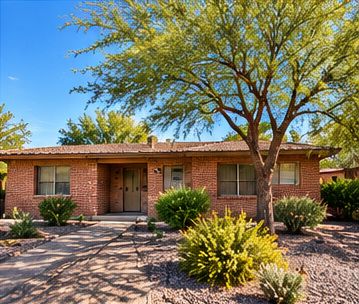
Yes.
Many homeowners assume they must complete extensive repairs before working with a real estate agent.
That isn't necessarily true.
Depending on the property, its condition, and current buyer demand, a home may be marketed publicly in its existing condition.
An as-is sale does not automatically eliminate disclosure obligations or other contractual requirements.
An experienced real estate professional can help evaluate whether making selective improvements, listing the property as-is, or considering a direct cash offer makes the most sense.
The goal is to understand your choices rather than assume there is only one practical way to sell.
What Can an Experienced Real Estate Agent Do Differently?

Image for illustrative purposes only. The individuals depicted are AI-generated and do not represent Billy Morris, actual clients, or a documented real estate transaction.
One of the biggest differences between accepting a direct investor offer and listing a property with a real estate professional is the opportunity for broader market exposure and representation.
When you work with a REALTOR® representing your interests as the seller, the objective is to develop a selling strategy based on your property, goals, and circumstances.
An experienced agent with a pulse on the local market can help you understand more than simply what your home might be worth.
Recently Sold Comparable Homes
What have buyers actually paid for properties similar to yours?
Recent comparable sales provide important evidence about market value.
Time on Market Before Going Under Contract
How long were comparable homes actively marketed before receiving an accepted offer?
Did those properties require price reductions? Were there changes in listing status or previous unsuccessful marketing attempts?
These details help establish realistic expectations about buyer demand and potential selling timelines.
Your Current Competition
What similar homes are currently listed for sale?
How do their asking prices, property conditions, locations, and features compare with yours?
Understanding the alternatives available to buyers can help inform a competitive pricing strategy.
Market Trends
Are inventory levels, buyer activity, pricing patterns, and marketing times changing in your neighborhood?
The conditions affecting your property may differ from broader Tucson-area averages.
Potential Net Proceeds
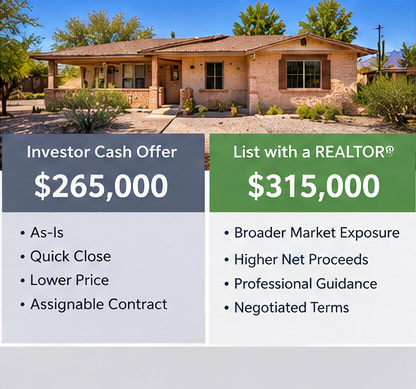
Illustrative financial comparison: Any prices or proceeds shown are hypothetical and are not a prediction or guarantee. Listing with a REALTOR® does not necessarily produce a higher selling price or greater net proceeds than an investor offer. Actual outcomes depend on property condition, market demand, commissions, closing costs, concessions, negotiated terms, and other expenses.
What Does the National Association of REALTORS® Say About Selling With an Agent?
According to the National Association of REALTORS®' 2025 Profile of Home Buyers and Sellers, homes sold with the assistance of a real estate agent had a significantly higher median selling price than homes sold by their owners without an agent.
-
Agent-assisted home sales: $425,000 median selling price.
-
For-sale-by-owner (FSBO) sales: $360,000 median selling price.
-
Difference: $65,000, approximately 18% higher relative to the FSBO median.
The report also found that 91% of home sellers used a real estate agent, while only 5% sold their homes without one.
These national statistics highlight why professional representation is worth considering when selling one of your most valuable assets.
However, the figures represent different groups of properties and sellers. They do not establish that an agent causes an 18% increase in selling price, nor do they measure the difference between investor cash offers and agent-assisted sales.
The real question is not simply what someone is willing to offer for your home today. It's what your property could realistically sell for, how long that might take, and how much equity you could retain after all selling expenses.
Before accepting an investor's offer, consider having an experienced REALTOR® evaluate your property, explain current local market conditions, and help you compare your options.
Source: National Association of REALTORS® — 2025 Profile of Home Buyers and Sellers. National median selling prices; not Tucson-specific data. Figures do not account for differences in property characteristics or transaction costs.
What could you realistically receive after commissions, closing costs, repairs, concessions, holding expenses, and other applicable selling costs?
A higher purchase price doesn't automatically result in higher net proceeds.
Comparing estimated outcomes can help you evaluate the financial trade-offs of each option.
Is a Cash Offer Ever the Right Choice?
Absolutely.
A direct cash sale may be appropriate when a homeowner places a high priority on convenience, limited property preparation, or a particular closing timeline.
A properly structured cash transaction with a capable buyer may provide meaningful advantages.
But every offer should be evaluated based on its actual terms—not simply whether the buyer advertises that they pay cash.
The best selling strategy is the one that realistically aligns with your financial goals, property condition, timeline, and tolerance for risk.
Behind on Mortgage Payments? Worried It's Too Late?
If you've fallen behind on your mortgage payments, received notices from your lender, or are facing the possibility of foreclosure, you may feel like you're running out of time and options.
Financial hardship can happen for many reasons. Unexpected expenses, loss of income, medical bills, divorce, or other life changes can make it difficult to keep up with homeownership costs.
When you're under that kind of pressure, an investor offering quick cash may seem like your only way out.
But don't assume that accepting the first cash offer is your only option—or that you've waited too long to seek help.
Depending on your circumstances, you may still have opportunities to explore mortgage assistance with your servicer, consult a HUD-approved housing counselor, or evaluate whether selling the property is financially appropriate.
A property listing or signed purchase agreement does not automatically stop a scheduled foreclosure. If a foreclosure deadline is approaching, contact your mortgage servicer and a qualified Arizona attorney promptly.
You've worked hard to build equity in your home. Financial hardship shouldn't automatically mean giving up more of that equity than necessary.
Don't let embarrassment, uncertainty, or fear prevent you from seeking help.
The time to act is now.
Before You Accept a Cash Offer, Know Your Selling Options
Selling a home can be challenging, particularly when you're facing financial pressure, unexpected circumstances, or a deadline that makes selling feel urgent.
Today's real estate market presents real challenges for homeowners who need to sell. Pricing, buyer demand, competing listings, property condition, and financing requirements can all affect how quickly a home sells and how much equity you ultimately retain.
You've worked hard to build equity in your home. You deserve the opportunity to protect as much of it as reasonably possible.
One of the most important steps you can take before accepting an unsolicited cash offer is to have a qualified Arizona real estate attorney review the purchase agreement.
An attorney can help you understand assignment provisions, cancellation rights, earnest-money requirements, potential title issues, and other contractual obligations.
You should also consider engaging an experienced, knowledgeable REALTOR® to represent your interests as the seller from the beginning of the process through closing.
A real estate professional who understands your local market can help you:
-
Evaluate your home's potential market value using recent comparable sales.
-
Understand current buyer demand, competing properties, and realistic selling timelines.
-
Compare investor cash offers with opportunities available through the open market.
-
Explore selling your property as-is, even if it needs repairs.
-
Evaluate estimated net proceeds, selling costs, timelines, and transaction risks.
-
Negotiate price, terms, contingencies, and closing arrangements in your best interests.
-
Coordinate the transaction and help you navigate important deadlines and obligations.
The goal isn't simply to sell your home. It's to help you make an informed decision that protects your interests and preserves as much of your hard-earned equity as the circumstances reasonably allow.
Find Out What Your Home Could Be Worth Before You Decide
I'm Billy Morris, GRI, MRP, REALTOR® and Associate Broker with Realty Executives Arizona Territory, serving Tucson, Vail, Sahuarita, Marana, Oro Valley, Corona de Tucson, and surrounding Southern Arizona communities.
My approach is straightforward:
Understand your circumstances. Review the market evidence. Evaluate your options. Develop a realistic strategy.
I'm not here to pressure you into listing your home. I'm here to help you make an informed decision about one of your most significant financial assets.
Whether you're considering a direct cash offer, selling as-is, or listing your home on the open market, start by understanding your property's potential value.
Before committing to an investor's offer, consider comparing your options.
Explore Your Selling Options & Request a Home Valuation
Billy Morris, GRI, MRP
REALTOR® | Associate Broker
Realty Executives Arizona Territory
Educational disclaimer: This article provides general real estate information and does not constitute legal, tax, financial, or foreclosure advice. Contract provisions, title issues, mortgage-assistance options, and legal rights depend on individual circumstances. Consult a qualified Arizona real estate attorney regarding legal concerns, particularly if foreclosure deadlines are approaching. Requesting a home valuation does not establish an agency relationship.
*Image and financial illustration disclaimer: Images appearing in this article are AI-generated representations created for educational purposes. They do not depict actual homeowners, real estate professionals, investor companies, property listings, or completed transactions. Any purchase prices, assignment fees, financial comparisons, or estimated proceeds presented as examples are hypothetical. Actual selling prices, expenses, timelines, and net proceeds vary by property and market conditions. No particular financial outcome is guaranteed.
Categories